
HTTP Versions Over The Years

🧩 Evolution of HTTP: Technical Overview
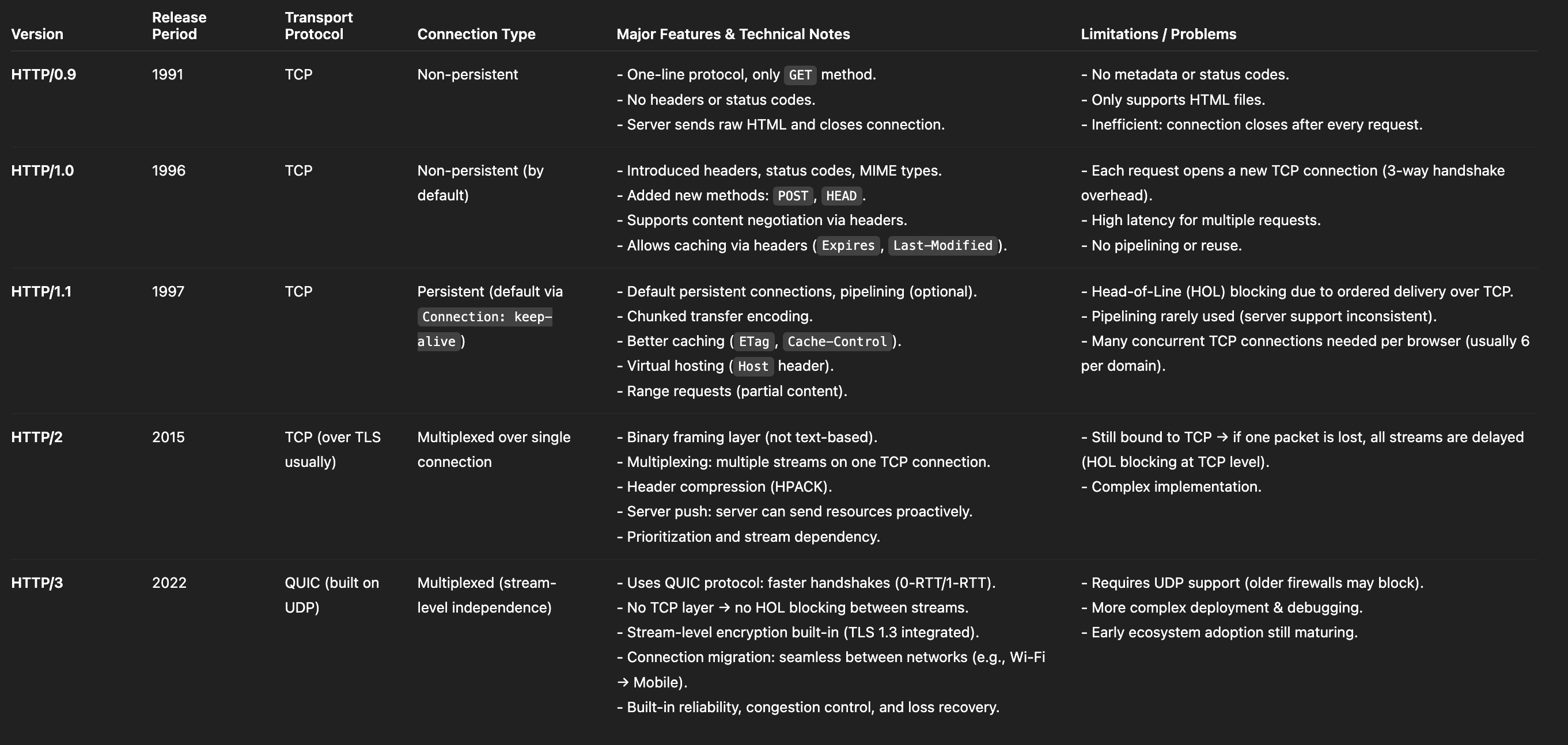
🔍 Conceptual Shifts by Version
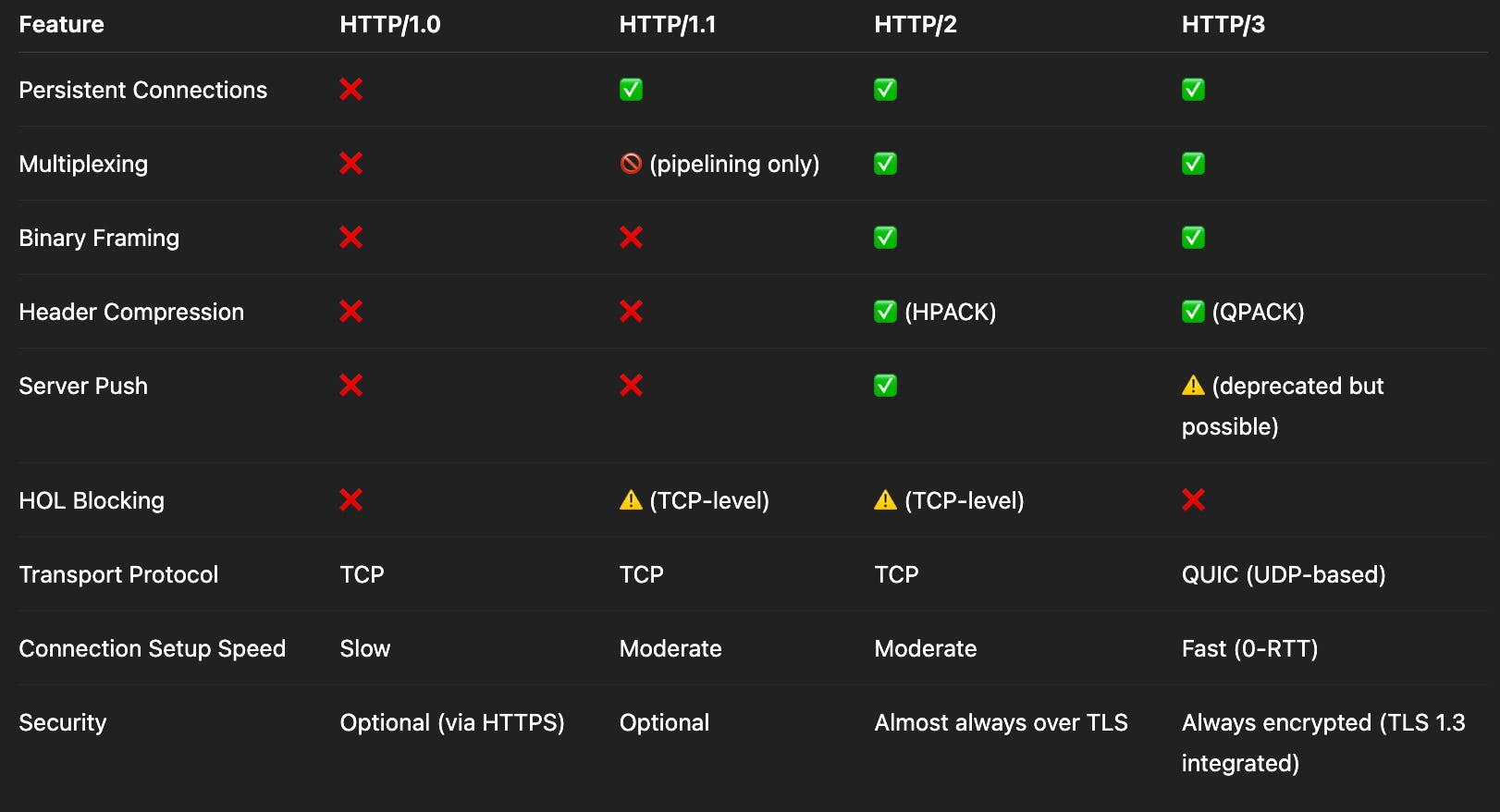
⚙️ Performance Summary
🧠 Summary Insights
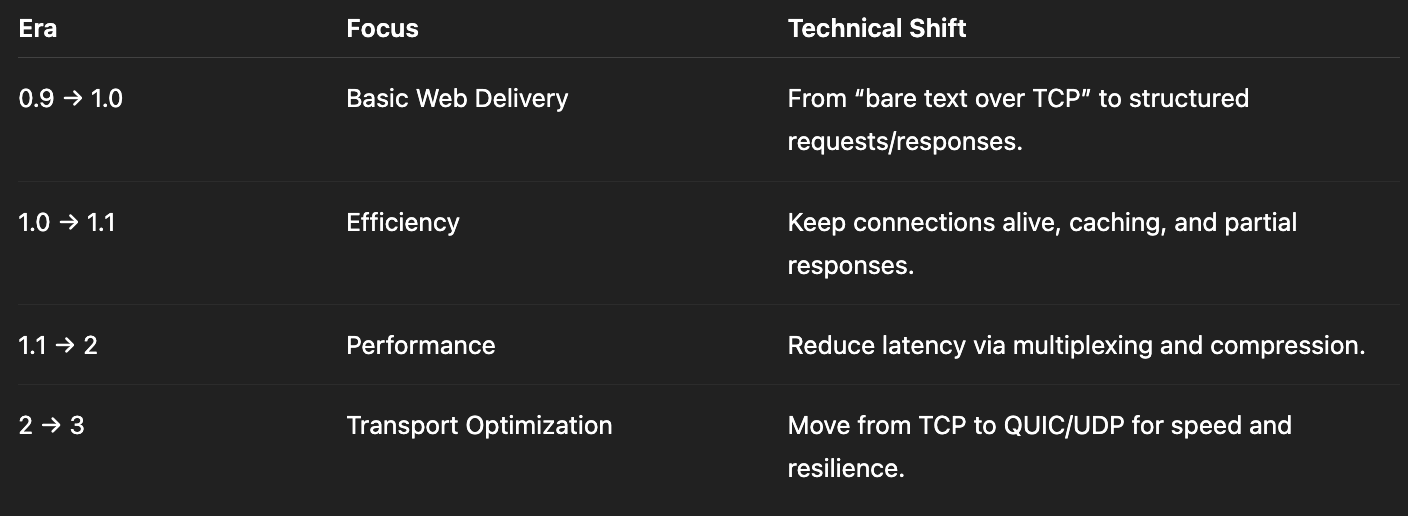
HTTP/1.0 → 1.1 focused on reliability and persistence.
HTTP/2 redesigned the layer beneath — binary framing and multiplexing — to improve speed on the same TCP base.
HTTP/3 completely re-engineered transport using QUIC to remove TCP’s Head-of-Line blocking, support faster handshakes, and make connections mobile-friendly.
Why this matters (for you as a developer/architect)
Performance optimisation: Understanding the differences helps you pick architectures (e.g., use HTTP/2/3) and diagnose bottlenecks (e.g., if still using HTTP/1.1, you may face connection overhead, HOL blocking).
Compatibility and fallback: Even though HTTP/2 and HTTP/3 exist, many systems still support or fallback to HTTP/1.1 (or even 1.0 in some edge cases). Designing robust systems means being aware of version negotiation (via ALPN, etc.).
Feature support: Some features (e.g., server push, multiplexing) only exist in later versions. If you rely on e.g., long‐lived streaming, chunked encoding, push, you must ensure the version supports it.
Networking & transport implications: Many “web performance” issues have their root not at the HTTP semantics layer, but at the transport layer (TCP handshake, congestion control, packet loss). HTTP/3 attempts to address many of these.
Evolution & future‐proofing: As the web evolves (mobile, IoT, high resource pages, latency-sensitive apps), older versions become performance handicaps. Knowing the evolution helps you plan upgrades.
Some extra technical subtleties and caveats
Even with HTTP/1.1 persistent connections, pipelining (sending multiple requests without waiting for responses) was part of the spec, but rarely used in practice because of head‐of‐line blocking and implementation issues.
With HTTP/2, while it reduced HTTP layer HOL blocking, TCP layer HOL blocking still remained: if a packet is lost on a TCP connection, all streams wait. This is one reason HTTP/3 moves to QUIC/UDP.
Adoption: Just because a server supports HTTP/2 or HTTP/3 doesn’t guarantee all resources are served via that version (some CDNs, third‐party domains, etc, may still use older versions) — performance gains vary. (Studies show e.g., HTTP/3 gives benefits mostly in high‐latency or lossy networks) (arXiv)
Implementation complexity: Upgrading a web stack to HTTP/2/3 may require changes (e.g., ALPN support, configuring servers/clients, load-balancers, proxies).
Backwards compatibility and fallbacks: HTTP versions are designed to be backwards compatible in semantics (methods, headers, status codes) so older clients/servers still work.
Transport security: Most modern HTTP uses TLS/HTTPS. HTTP/2 essentially requires TLS when used in browsers (though spec allows clear-text) and HTTP/3 integrates TLS within QUIC.